When architecture defies gravity, it ceases to be a mere shelter and becomes a profound statement of human engineering. For the uncompromising modernist, a cliffside is not a barrier—it is an invitation to suspend thousands of tons of raw, post-tensioned concrete directly over the abyss. In this 2026 design manual, we explore 18 gravity-defying residential structures that anchor into solid rock faces, thrusting massive geometric volumes out into open air. These estates do not gracefully sit on nature; they command it through tectonic weight and sheer structural audacity.
Tectonic Overhangs & Gravity-Defying Anchors
The art of the cantilever lies in the absolute tension between the mountain’s solid mass and the building’s weightless extension. These concepts utilize extreme engineering to extend your living space out into the sky.
Idea #1: The 40-Foot Single-Pour Post-Tensioned Living Capsule
Cast a massive, unbroken rectangular concrete living box that launches 40 feet out from a shear granite cliff face, supported entirely by internal high-tensile steel cables anchored 60 feet deep into the mountain.
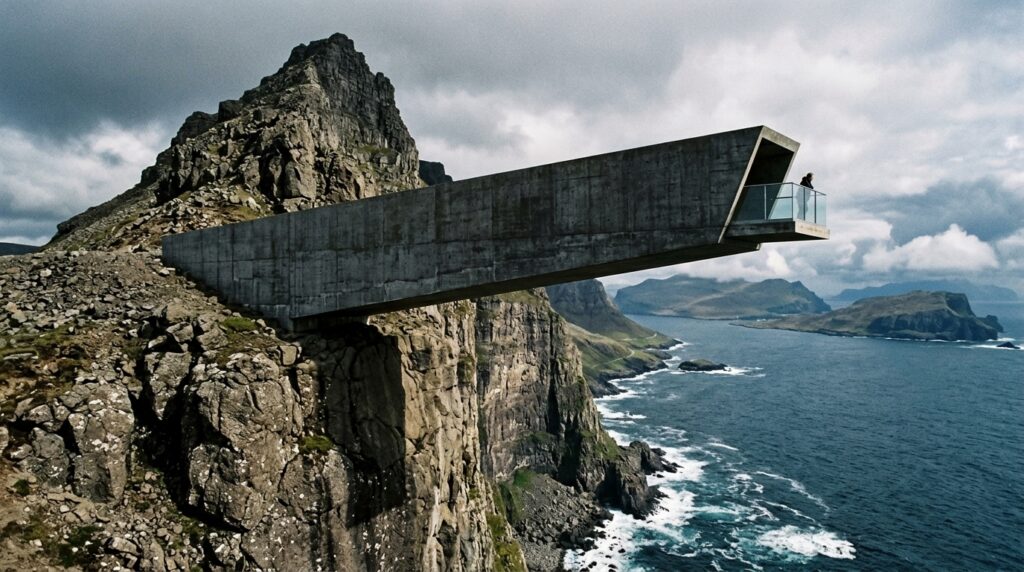
- My Perspective: Columns under a cliffside villa completely ruin the illusion of suspension. A true post-tensioned cantilever feels thrilling because it creates a high-contrast relationship between the heavy material density of raw concrete and the empty space beneath it.
- What I would add: A flush-mounted structural glass floor panel spanning the final 10 feet of the cantilever’s nose, allowing you to look straight down a 300-foot drop while standing inside the living room.
Idea #2: Asymmetrical Interlocking Board-Formed Pylons
Secure the villa to the rocky topography using a vertical core matrix of giant, interlocking board-formed concrete pillars that mirror the natural vertical fractures of the cliffside.
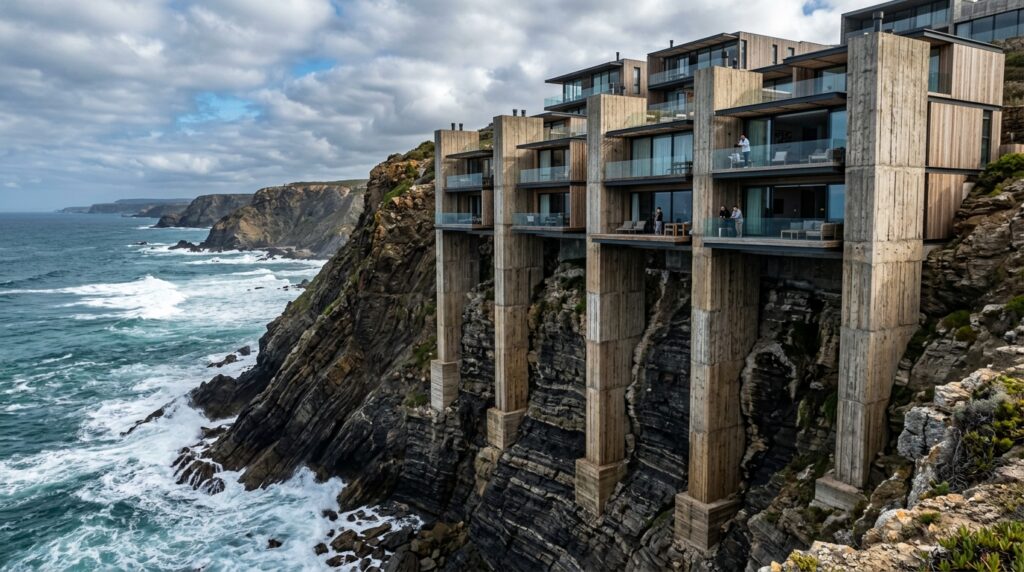
- My Perspective: Standard foundation walls look like a basic basement block. Elevating the structural core into geometric, textured concrete pylons honors the heavy, industrial-luxury aesthetic while anchoring the building against intense wind shear.
- What I would add: Integrating recessed, linear fiber-optic lighting channels vertically up the entire length of the pylons to highlight the deep timber-grain texture from dusk until midnight.
Idea #3: The Counterweighted Titanium-Strap Exoskeleton
Wrap the exterior of a raw concrete cantilevered structure with heavy, exposed industrial straps of sandblasted black titanium that bolt directly into the overhead mountain caprock.
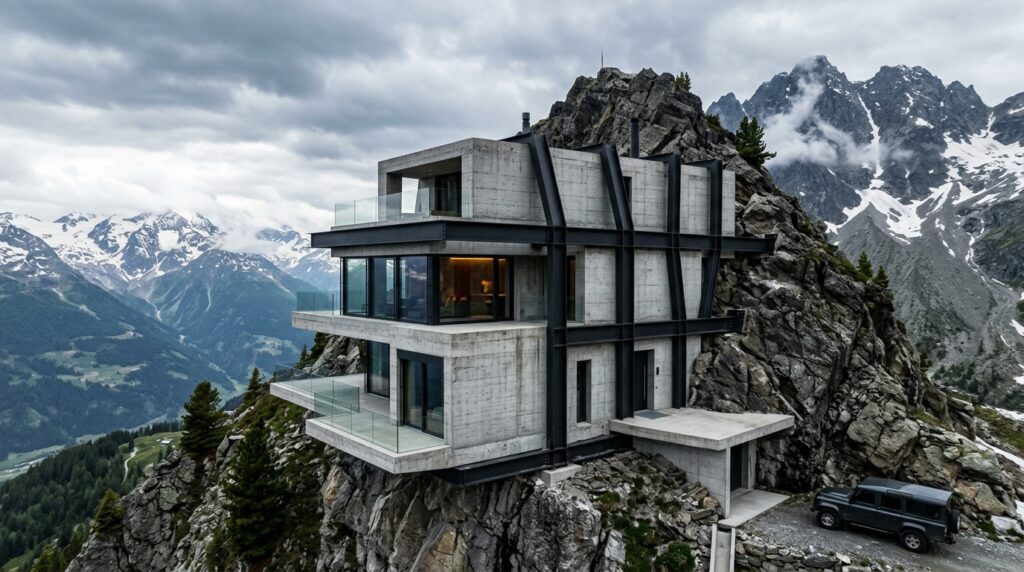
- My Perspective: Don’t hide the engineering that keeps the house from falling. Exposing the structural titanium straps celebrates honest architectural physics, giving the home a secure, bulletproof fortress appearance.
- What I would add: Specialized load-cell strain gauges integrated directly into the titanium anchor bolts that stream real-time structural tension data to your smartphone dashboard.
Inside these cliffside fortresses, the interior spaces are framed by deep shadow lines, micro-cement finishes, and massive structural openings that frame panoramic horizons without distracting details.
Idea #4: Monolithic Raw Micro-Cement Spatial Shells
Coat the entire interior architecture—including floors, walls, ceilings, and built-in furniture blocks—in a continuous, matte-finished charcoal micro-cement matrix.
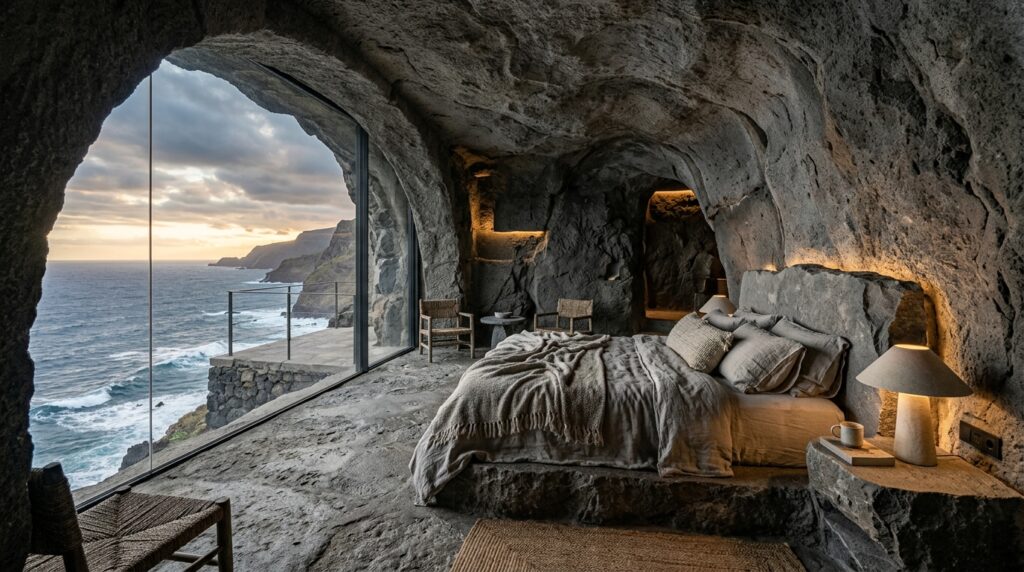
- My Perspective: Trims, baseboards, and paint variations clutter the visual field. A uniform micro-cement shell creates a silent, museum-grade backdrop that focuses all your sensory attention on the sweeping horizon outside.
- What I would add: An active sub-floor and in-wall hydronic radiant heating network running through the entire micro-cement layer to ensure the raw stone surface feels warm and luxurious to the touch.
Idea #5: Razor-Sharp Deep Shadow-Gap Ceiling Joints
Introduce a continuous, 2-inch wide by 2-inch deep recessed aluminum shadow channel at every single intersection where the raw concrete walls meet the ceiling plane.
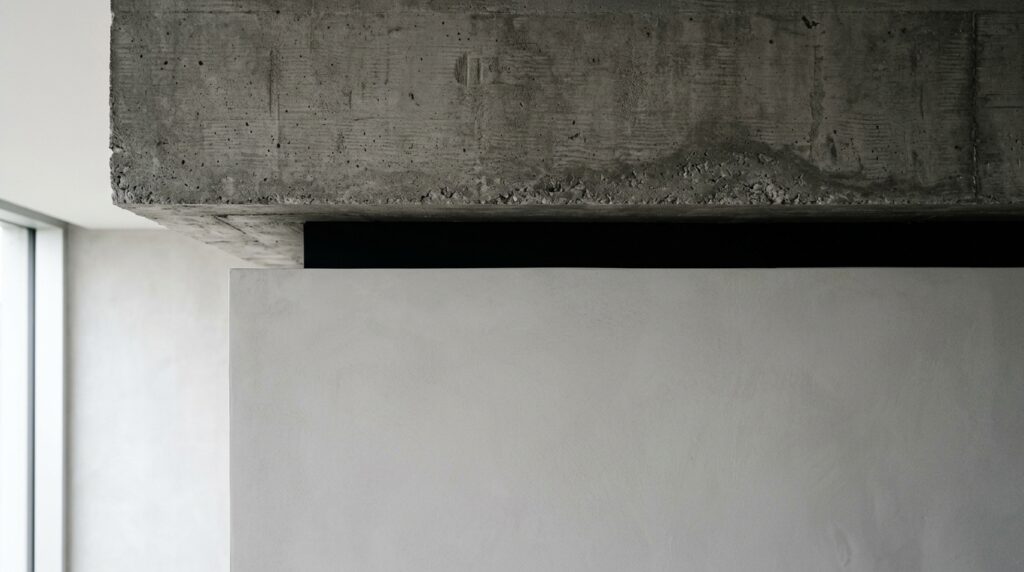
- My Perspective: When you are dealing with thousands of tons of single-cast concrete, standard flush joints look unfinished. A deep shadow gap creates a sharp line of darkness, making the massive overhead roof slabs look like they are floating on columns of air.
- What I would add: Concealing ultra-slim, low-glare 2400K warm LED light strips deep within the shadow channel to cast a moody, downward wash of ambient light across the concrete faces.
Idea #6: Frameless Hydraulic Recessed Window Tracks
Install massive, 15-foot-tall structural glass panes that slide completely down into hidden sub-floor pockets via heavy-duty hydraulic pistons, converting the living zone into an open-air platform.
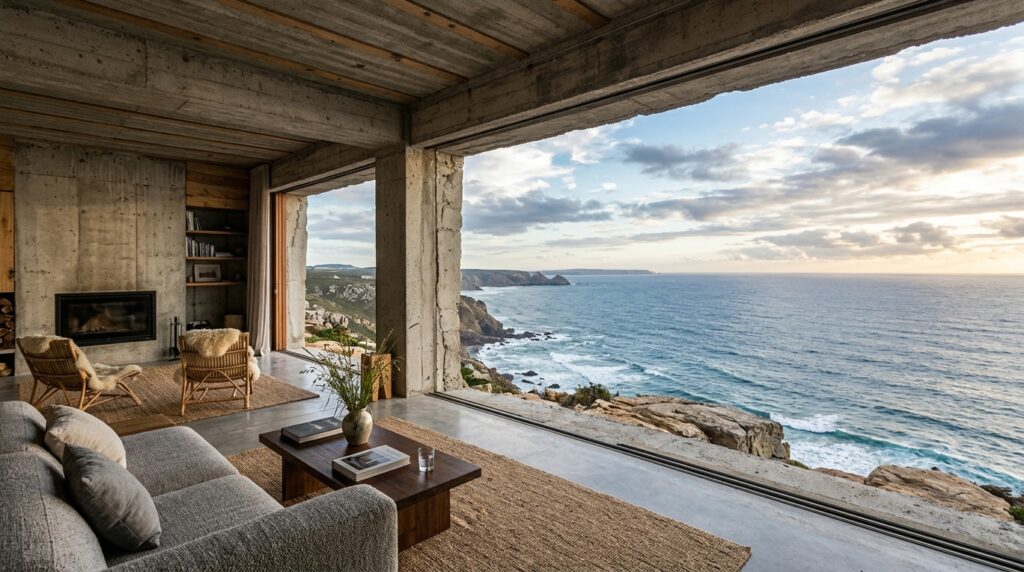
- My Perspective: Even the slimmest window frames break up a perfect view. Sinking the glass entirely into the concrete floor matrix removes all boundaries, completely merging your high-end interior with the raw outdoor atmosphere.
- What I would add: An automated wind-speed sonic radar that triggers the hydraulic lift pistons to raise the heavy glass walls back into place the moment coastal wind speeds cross 35 miles per hour.
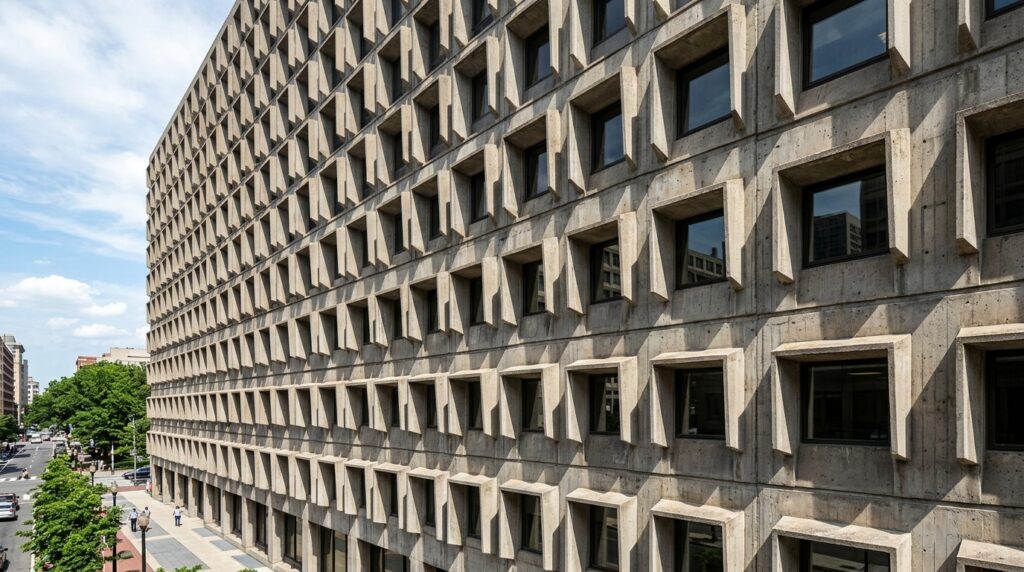
Idea #7: Deep-Set Boxed Concrete Viewing Portals
Design deeply recessed, rectangular window boxes cast directly out of the main concrete facade, acting as structural sun-shades that shield the interior from harsh solar glare.
- My Perspective: Standard flush glass gets scorched by direct sunlight. Deep concrete box frames act as permanent structural visors, keeping the villa cool while adding immense architectural depth and sculpture to the exterior.
- What I would add: Sinking a linear micro-drainage channel inside the base of each concrete box frame to completely prevent rainwater from dripping down and staining the outer facade.
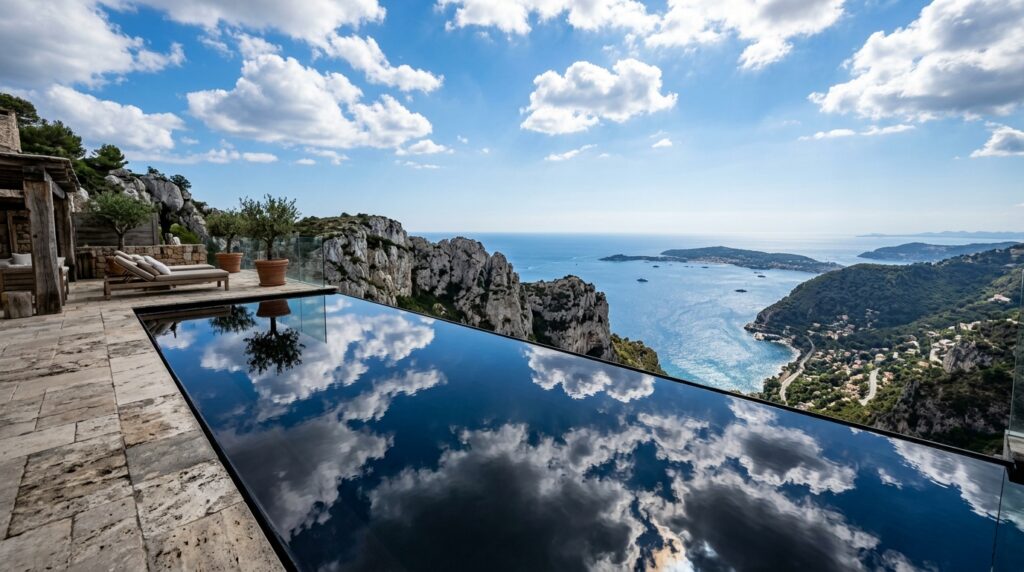
Idea #8: Polished Black Terrazzo Horizon Water Mirrors
Construct a zero-edge reflection pool running along the outermost tip of the concrete cantilever, surfaced completely in hand-polished, deep black aggregate terrazzo.
- My Perspective: Traditional blue pool tiles look like a basic holiday resort. A polished black terrazzo water mirror mimics a natural volcanic rock pool, creating an optical illusion where the water surface blends seamlessly into the ocean horizon below.
- What I would add: A completely hidden, silent sub-surface water circulation pump that keeps the mirror surface perfectly flat and still, even during heavy afternoon coastal breezes.
Idea #9: Stacked Geometric Cantilevered Terraces
Layer multiple rectangular concrete floor plates on top of each other, rotating each level exactly 15 degrees off-axis to create an alternating zig-zag pattern down the cliff face.
- My Perspective: Stacking rooms symmetrically like a boxy apartment looks uninspired. Rotating the cantilevers maximizes privacy between levels and ensures that each floor captures a entirely unique angle of the landscape.
- What I would add: Heavy, custom-engineered structural steel tie-rods running internally through the overlapping corners to distribute seismic forces evenly down to the mountain foundation.
Idea #10: The Inverted Concrete V-Support Pylon
Support a massive mid-level villa extension using an oversized, single-pour inverted “V” concrete brace that pins directly into a natural stone ledge below the house.
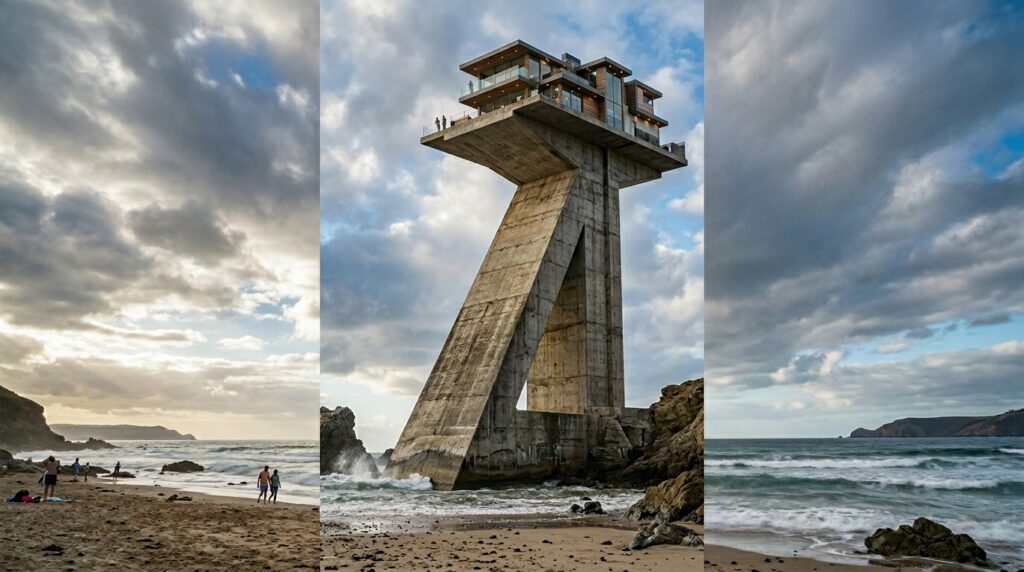
- My Perspective: A single massive triangular brace feels incredibly powerful and architectural. It reduces the number of contact points with the fragile cliffside while showcasing bold structural physics.
- What I would add: Sandblasting the lower half of the concrete brace to expose the heavy granite aggregate beneath, matching the rough texture of the mountain stone it rests upon.